Evapotranspiration and Water Balance Maps
Evapotranspiration (ET), Potential Evapotranspiration (PET), and their corresponding water balance maps are provided in the sections below to help illustrate current moisture conditions and atmospheric water demand. These maps show how precipitation, ET, and PET interact to influence soil moisture availability, potential dryness, and overall hydrologic conditions across the region.
ET Maps
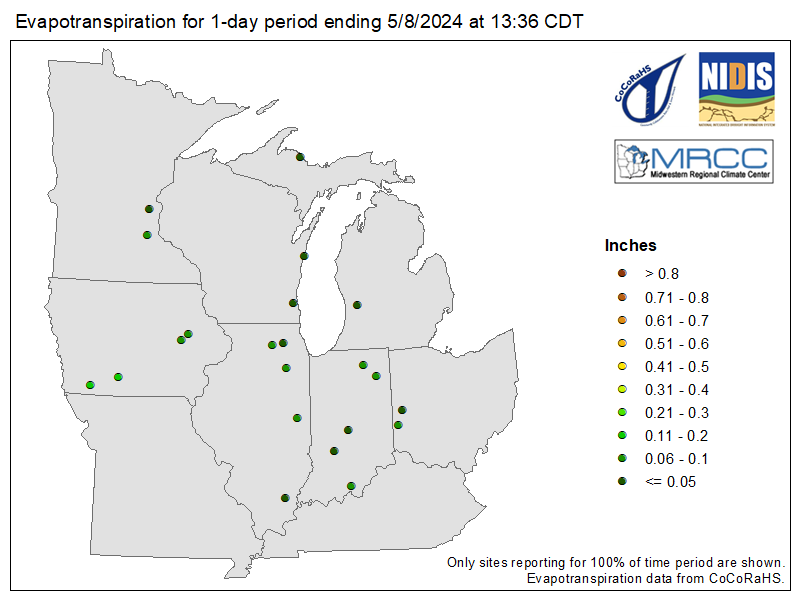
Evapotranspiration (ET) is the process through which water is transferred from the land to the atmosphere by two means: evaporation from soil and surface water and transpiration from plants. It is a crucial part of the water cycle and represents the combined loss of water from a specific area. The rate of ET depends on several factors, including temperature, humidity, wind speed, solar radiation, and the characteristics of the vegetation. Understanding evapotranspiration is important for agriculture, hydrology, and water resource management, as it helps in estimating water requirements for crops and assessing water availability in an ecosystem.
ET Maps utilize CoCoRaHS ET data.
| 1-Day | 7-Day | 14-Day | 30-Day | 60-Day |
|---|---|---|---|---|
![]() |
![]() |
![]() |
![]() |
![]() |
![]() |
![]() |
![]() |
![]() |
![]() |
ET Water Balance Maps (Precip minus ET)
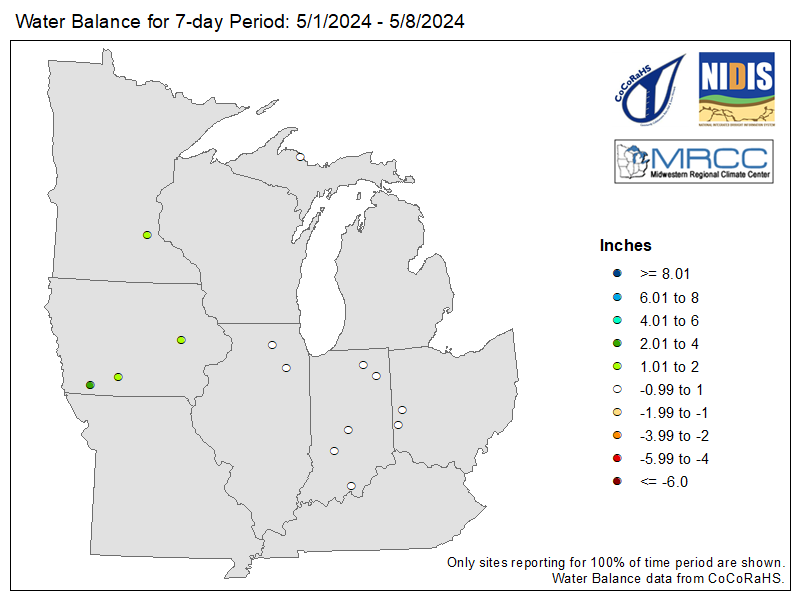
The hydrologic cycle is largely driven by two key components: precipitation and evapotranspiration. The water balance maps track these components by representing incoming moisture (precipitation) against outgoing moisture (ET). When precipitation meets or exceeds evapotranspiration, there is a surplus of water, which can lead to lush vegetation, replenishment of soil moisture, and increased runoff and streamflow. Conversely, if evapotranspiration regularly surpasses precipitation, it can result in wilting vegetation, reduced streamflow, and the need for irrigation to maintain the health of lawns, gardens, and agricultural fields.
Water Balance Maps utilize CoCoRaHS data.
| 7-Day | 14-Day | 30-Day | 60-Day |
|---|---|---|---|
![]() |
![]() |
![]() |
![]() |
![]() |
![]() |
![]() |
![]() |
PET Maps
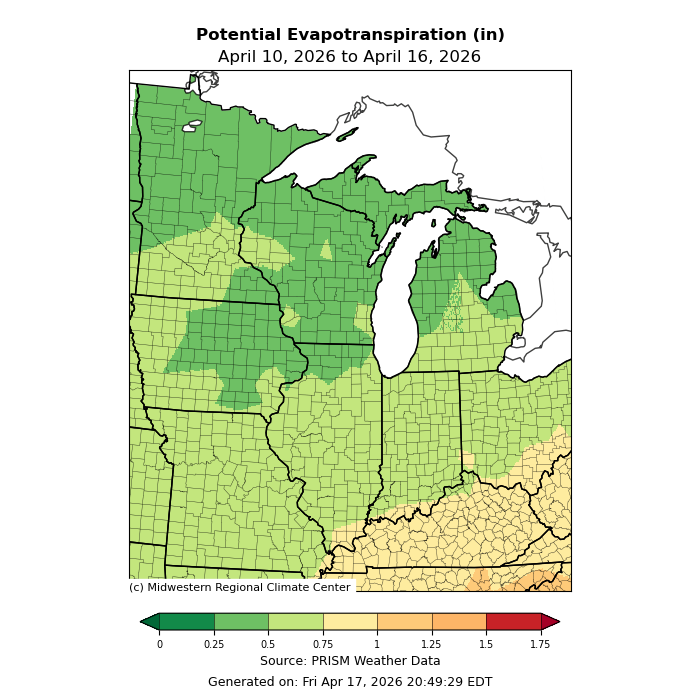
Potential Evapotranspiration (PET) represents the amount of water that could be transferred from the land to the atmosphere through evaporation and transpiration if sufficient moisture were available. Unlike actual evapotranspiration (ET), PET assumes an unlimited water supply and reflects the atmospheric demand for water. PET is primarily influenced by temperature, solar radiation, humidity, and wind speed, which together determine the energy available to drive evaporation and plant transpiration. Because PET measures the atmosphere’s drying power, it is widely used in agriculture, hydrology, and climate monitoring to evaluate crop water demand, assess drought conditions, and support water resource planning.
| Observed | Forecast |
|---|---|
|
|
PET Water Balance Maps (Precipitation minus PET)
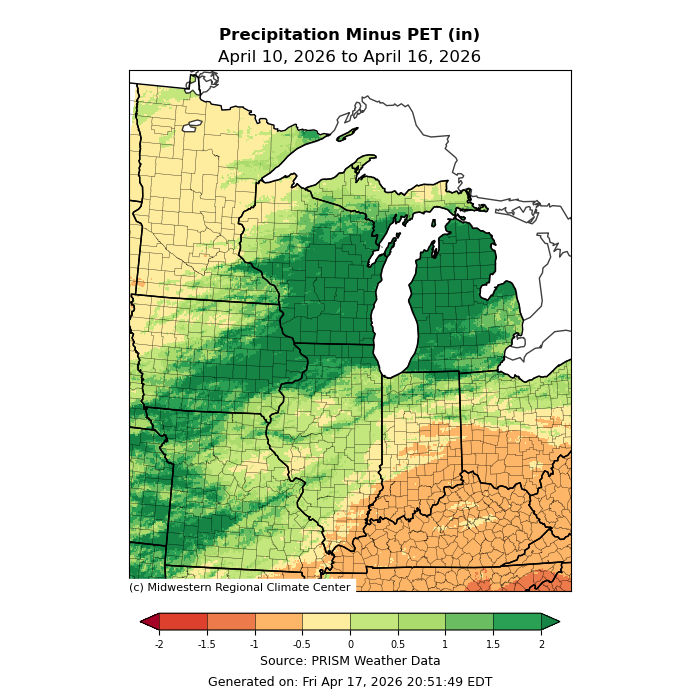
Precipitation minus Potential Evapotranspiration (P − PET) represents the balance between incoming water from precipitation and the atmospheric demand for water. Positive values indicate that precipitation exceeds the evaporative demand, suggesting a surplus of moisture that can contribute to soil water recharge, runoff, or groundwater replenishment. Negative values indicate that atmospheric demand exceeds precipitation, reflecting a moisture deficit that can lead to drying soils, increased irrigation needs, and potential drought stress. This metric is commonly used to assess short- and long-term water availability and to monitor evolving wet or dry conditions.
| Observed | Forecast |
|---|---|
|
|